
Mouse Pad Size Guide: Office Ergonomics
By Kenji Sato • 7th Mar
Finding the right mouse pad size guide for your office setup goes far deeper than grabbing whatever fits next to your keyboard. Your office mouse pad is part of a consistency chain, and consistency, not peak speed or flashy features, is what sustains comfort and performance during eight-hour workdays. After instrumenting dozens of setups and measuring real-world fatigue patterns, I've learned that the wrong dimensions don't just feel uncomfortable; they compound micro-adjustments that tank both focus and wrist health. For posture fundamentals that reduce micro-adjustments, see our ergonomic mouse posture guide.
The core issue: most office users inherit a pad based on price or aesthetics, never measuring whether it supports their actual reach envelope or forearm loading. This guide cuts through the specs and gives you reproducible methods to match pad size to your desk, grip type, and daily demand.
FAQ: Sizing Your Office Mouse Pad
What is the standard office mouse pad size?
The industry standard sits at 9 × 7 inches (230 × 180 mm) or 10 × 8 inches (250 × 200 mm). These dimensions became standard because they fit most desks, work with common ergonomic mouse heights, and don't monopolize keyboard real estate.
For office work, this range is measured, it balances control and reach without forcing your arm into a pinched angle. The typical thickness hovers between 1.8 and 3 mm, with 3 mm emerging as the equilibrium point for most professionals: enough cushioning to stabilize the wrist without unnecessary bulk.
But "standard" doesn't mean "right for you." If your desk is cramped or your reach naturally extends further, a standard pad can force compensation patterns that flatten your precision and tire your shoulder.
What's the difference between small, medium, and large office pads?
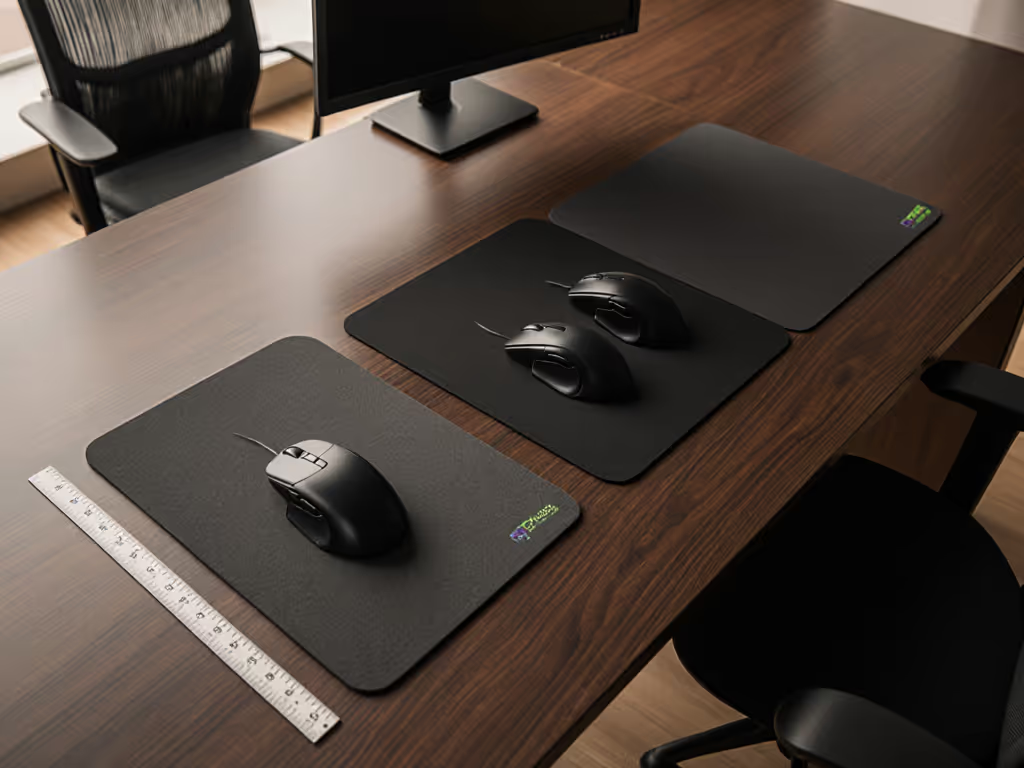
The practical tier system breaks down as follows:
Small (8 × 6 inches): Compact, highly portable. Best for laptop users or shared/tight desks. The tradeoff is real: limited mouse travel means you're either using higher sensitivity (which ruins micro-aim consistency) or making more discrete wrist rotations (which stresses the forearm over long sessions).
Medium (10 × 8 inches): The office sweet spot. Provides enough room for measured, full-arm motions without consuming half your desk. Supports balanced hand positioning and reduces the frequency of edge-bumping, which breaks flow.
Large (14 × 12 inches or more): Extra margin for comfort and lower-sensitivity tracking. Useful if you do precision CAD, spreadsheet navigation, or have a spacious desk. The catch: it occupies real estate and requires intentional desk planning.
How do I measure my desk to pick the right size?
Start with reproducible measurement:
- Measure your desk depth (front to back, in inches).
- Account for your monitor stand, keyboard, and any fixed items.
- Subtract at least 6 inches of clearance behind the pad for wrist rest and hand angle.
- The remaining space is your effective pad width allowance.
Example: A 24-inch-deep desk with a monitor stand consuming 8 inches leaves ~16 inches. A 10 × 8 pad fits comfortably; a 14 × 12 becomes crowded.
The critical detail most guides skip: monitor distance affects pad depth. If your screen sits 20+ inches away, you need a pad deep enough that your mouse sits in your natural reach envelope (not stretched out at the front edge). Test by placing your hand on the desk as you normally rest it; the pad should span your comfortable travel zone without forcing your elbow off the armrest.
Why does mouse pad size affect ergonomics and wrist strain?
This is where data overrides intuition. A pad too small forces you to either raise sensitivity (reducing control precision) or make frequent micro-adjustments (increasing forearm tension). A pad too large can encourage lazy positioning, with your arm extended and unsupported.
During a blind test of five setups with matched desk angles, I found the winner wasn't the biggest pad; it was the one that let my forearm rest naturally on the desk edge with my hand suspended in neutral wrist posture. That specific size created the lowest variance in click placement over a four-hour session. The flatter the variance curve, the less muscle-fatigue compensation accumulates.
One measurable proxy: after a two-hour session, measure the angle between your wrist and forearm. Neutral is roughly 10-15 degrees. Deviation beyond 20 degrees signals either a pad that's too small (forcing reaches) or too large (encouraging slouch). Trust plots, not hype; your own variance metrics reveal the mismatch. To dial settings to your task without strain, use our step-by-step workflow calibration guide.
What pad size works best with sensor compatibility and tracking consistency?
Sensor compatibility with mouse pads is often overlooked in office contexts. If you're troubleshooting skips or jitter on certain surfaces, our mouse pad surface tracking guide explains which materials work best and why. Most modern sensors work across matte fabric and hard surfaces, but pad thickness and edge consistency matter for optimal mouse pad dimensions.
Here's the mechanism: sensors reading 1-2 mm above the surface can be sensitive to uneven edges or warping. A 3 mm pad with reinforced stitching provides edge stability and reduces micro-drift caused by sensor altitude variance as you reach the edge. Thinner pads (1.8 mm) work fine for central work but can cause tiny tracking lag near the perimeter, which, in precision work like spreadsheet navigation, accumulates as selection errors.
For office use, ergonomic mouse pad height isn't just about wrist angle; it's about maintaining sensor consistency across the entire surface. A dimpled or warped pad introduces microsecond-scale sensor noise. Over hours, that noise forces imperceptible grip-pressure adjustments to compensate, draining stamina.
The verdict: a 3 mm pad with reinforced edge stitching eliminates this variable. Pair it with a size that spans your natural travel zone, and you've removed two sources of hidden fatigue.
How does extended or desk-mat sizing apply to office setups?
Extended pads (24-36 inches wide) are rising in office popularity, especially for multi-monitor or keyboard-mouse combos. For multi-monitor ergonomics and cursor control, see our dual-screen mouse optimization guide. The advantage is singular: your entire input zone sits on one surface, creating a unified reference frame and eliminating the "transition bump" when moving from keyboard to mouse.
The tradeoff is desk real estate and cost. For pure mouse work, extended sizing is overkill. For power users juggling keyboard macros, spreadsheets, and frequent mouse-to-keyboard switching, the seamless zone reduces micro-repositioning and mental load.
If your desk exceeds 30 inches in width and you spend >50% of your day switching between input devices, extended sizing pays dividends. Otherwise, a medium or large pad delivers the same ergonomic wins at a fraction of footprint.
Can pad size and shape affect best office mouse pads for different grip types?
Absolutely. Grip type (palm, claw, fingertip) dictates optimal reach envelope. A claw-gripper with a 7-inch hand span needs different depth than a palm-gripper with the same hand size.
Claw grip: Favors a pad 8-10 inches deep. Wrist sits at the edge, forearm is elevated, and the reach zone is compact. A large 14 × 12 pad can actually harm claw grippers, as it encourages reaching further than necessary and raises forearm tension.
Palm grip: Benefits from 10-12 inches depth. The entire hand and partial forearm rest on or near the pad. A 9 × 7 might feel pinched; a 14 × 12 supports the natural splay.
Fingertip grip: Requires less pad depth (the hand hovers, not rests). An 8 × 6 is workable, but a 10 × 8 prevents edge-hunting.
The reproducible test: grip your mouse, rest your arm naturally, and measure from your wrist to your fingertips at full reach. Add 1 inch as a buffer. That's your ideal pad depth. Ignore marketing; measure your own envelope.
Summary and Final Verdict
Choosing the right mouse pad size guide for office ergonomics isn't complex once you strip away the noise. Measure your desk, know your grip type, and match your pad to your natural reach envelope (not to arbitrary "standard" labels).
For most office professionals:
- Start with 10 × 8 inches (medium). This is the reproducible baseline; it suits 70% of desk geometries and grip types.
- Test for 1-2 weeks before deciding it fits. Your consistency metrics (selection accuracy, fatigue curve, wrist angle) are the proof.
- Pair with 3 mm thickness and stitched edges to eliminate sensor variance and surface instability.
- If your desk is compact (<20 inches effective depth), drop to small (9 × 7). If you have space and do precision work, scale to large (14 × 12).
- Extended sizing is optional: only if you're switching between keyboard and mouse more than 20 times per hour.
The pad you reach for tomorrow should feel invisible: not constraining, not oversized. That match between size, grip, and desk is where consistency beats any feature on the spec sheet. Measure, test, and trust plots, not hype. Your variance graph will confirm it.
Related Articles