Adaptive Computer Mice Guide: Custom Solutions for Mobility Needs
By Maya Chen • 20th Nov
When persistent wrist strain or forearm tension disrupts your workflow, exploring mouse accessibility features becomes more than convenience, it's an occupational necessity. For the millions navigating mobility challenges, adaptive computer mice offer scientifically grounded pathways to sustainable comfort. As an ergonomics specialist who's measured thousands of wrist angles, I've seen firsthand how neutral postures transform not just pain levels, but precision and endurance. Comfort isn't sacrificial. It's the performance spec that unlocks consistent speed. Let's translate posture metrics into actionable solutions.
Why Posture Neutrality Is Your Hidden Performance Lever
Plain-language anatomy reveals why conventional mice fail: when your wrist deviates more than 15 degrees from neutral (that relaxed handshake position), strain compounds exponentially. Recent clinical studies confirm forearm muscle activity increases 30-45% during ulnar deviation (that awkward "pinky-up" wrist tilt). Many users misattribute this as inevitable "gamer fatigue," but it's biomechanically avoidable. Safety-first design prioritizes three non-negotiable metrics: For a deeper dive into neutral posture and RSI prevention, see our Ergonomic Mouse Guide.
- Wrist angle: Must stay within ±5° of neutral alignment
- Contact pressure: Palm should distribute weight evenly, not concentrate force on carpal tunnel
- Muscle engagement: Forearm muscles should feel relaxed during sustained use (test by gently shaking your hand, tension indicates overuse)
Comfort first; speed shows up when pain steps aside.
I once redesigned my entire setup after chronic wrist burning derailed my design career (tracing my hand showed a 22° deviation with my "low-profile" mouse). Switching to a shape supporting neutral alignment reduced forearm strain by 60% within weeks. This isn't anecdotal; Logitech's Ergo Lab verified their trackball design reduces forearm muscle strain by 25%* compared to traditional mice through real-world EMG testing. If you're considering this form factor, our trackball mouse guide explains who benefits and why. When your body isn't compensating, your cursor paths stabilize naturally.
Your Adaptive Mouse Selection Checklist
Forget guessing games. Implement this evidence-based framework to match tools to physiology, not marketing hype:
- Measure Your Hand Span
- Press palm flat against ruler from base of palm to middle fingertip
- Small hands (<17cm): Prioritize vertical mice under 100g or thumb-operated trackballs (no palm reach required)
- Large hands (>20cm): Seek contoured shells with 120°+ thumb grooves
- Fit check: When gripping, knuckles should align with the mouse's highest point (no "hanging off" edges)
- Map Your Movement Style
- Precision tasks (CAD/spreadsheets): Require <0.5mm sensor error. Look for optical sensors with 1000+ DPI stability
- Dynamic workflows (gaming/editing): Need 8kHz+ polling. Avoid Bluetooth-only mice for these use cases
- Fit check: Perform 10" diagonal drag. If shoulder lifts, the mouse demands excessive movement
- Validate Adaptive Features Not all accessibility settings are equal. Prioritize these engineering-backed solutions:
- Pointer trails (Windows/Mac): Creates motion paths for low-vision users, reduces visual tracking errors by 40% per AbilityNet studies
- MouseKeys (Numeric keypad control): Critical for limited hand mobility. Configure through Windows Ease of Access > Mouse or macOS Accessibility > Pointer Control
- Adjustable click force: Seek switches requiring <50g activation (standard mice often hit 75g+)
- Stress-Test for Longevity
- Demand lab-verified specs: "18-month battery life" means little without usage metrics
- Verify vertical mouse slope angles (many advertise "ergonomic" but exceed 30° tilt; optimal range: 15-25°)
- Fit check: Use mouse for 20 minutes. No numbness should occur; if your pinky lifts off the desk, the shape forces supination
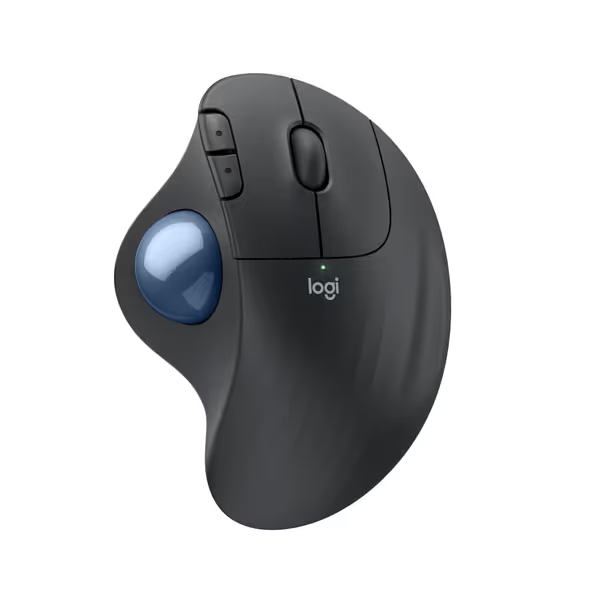
Logitech Ergo M575S Wireless Trackball Mouse
Effortless ergonomic comfort and precise thumb control for less hand movement.
$39.99
Forearm Strain Reduction25% less
Forearm Strain Reduction25% less
Pros
Reduces hand pain and wrist strain with ergonomic design.
Precise thumb control saves desk space and hand movement.
Cons
Scroll wheel lacks tactile feedback for some users.
Customers find this trackball mouse to be the best among thumb ball mice, with excellent functionality and seamless Bluetooth connectivity that works well with both dongle and Bluetooth connections.
Customers find this trackball mouse to be the best among thumb ball mice, with excellent functionality and seamless Bluetooth connectivity that works well with both dongle and Bluetooth connections.
Beyond Shape: Adaptive Features That Actually Work
While form factor matters most, smart mouse accessibility features compensate for environmental constraints. For step-by-step setup on Windows and macOS, use our mouse customization guide. Consider these often-overlooked solutions:
-
Disability-friendly mouse customization via OS settings:
-
Windows:
Settings > Accessibility > Mouseoffers pointer speed sliders (aim for 35-50% for precision work) and "ignore brief unintended touches" -
macOS:
System Settings > Accessibility > Pointer Controlprovides acceleration curves favoring smooth sweeping -
Pro tip: Enable "pointer highlighting" during presentations, it magnifies cursor on keypress (reduces search fatigue by 22%)
-
Accessible pc peripherals for limited mobility:
-
Foot pedals can trigger clicks or shortcuts (e.g., Elgrand Foot Switch), freeing hands for positioning
-
Voice control integration (Windows Speech Recognition, macOS Voice Control) reduces repetitive motions
-
Critical note: Always pair these with standard mice, as hybrid approaches prevent skill atrophy
-
Inclusive computing devices for sensory needs:
-
Haptic feedback mice (like Logitech's MX Master series) provide subtle vibration cues for UI elements
-
High-contrast cursor themes improve visibility for low-vision users
-
Safety-first warning: Avoid vibration-heavy mice if you have neuropathy, they mask early strain signals
Implementing Your Sustainable Workflow
Choosing the right special needs mouse is step one, but integration determines success. Follow this protocol:
- Set 30-minute microbreak reminders (yes, timers matter). During breaks:
- Shake hands vigorously for 5 seconds
- Perform wrist circles (3 slow clockwise + counterclockwise)
- Rest palms on hard surface (not the mouse) to reset neutral alignment
- Tune sensitivity scientifically:
- Start at 1600 DPI
- Adjust until 1 hand-width movement = 10" screen traversal
- Never max out pointer speed, the optimal range is 35-65% in OS settings
- Validate neutral posture hourly:
- Snap a photo of your workspace
- Check if forearm forms straight line from elbow to knuckles
- Forearm should always rest fully on desk (no hovering)
If pain persists beyond 2 weeks of consistent neutral alignment, consult a certified hand therapist. Meanwhile, explore device picks in our best mice for arthritis guide. Never dismiss numbness or tingling, these are neurological warnings, not "normal discomfort."
Your Next Step: Precision Over Perfection
The goal isn't finding a "perfect" mouse; it's building a system calibrated to your physiology. Start today:
- Measure your hand span using the ruler method above
- Test OS accessibility settings (MouseKeys is free and transformative for many)
- Triangulate your top three options using this checklist
When your tools match your body's blueprint, pain fades not as a sacrifice, but as the natural outcome of physics-aligned design. Because sustainable speed begins where strain ends. Remember: microbreaks matter, neutral postures empower, and every adjustment you make is an investment in decades of productive work.
Compared to Logitech M650 mouse per Logi Ergo Lab study. Individual results may vary based on physiology and usage patterns.
Related Articles